Obsessive-Compulsive Disorder (OCD)
What Is Obsessive Compulsive Disorder (OCD)?
Obsessive-Compulsive Disorder (OCD) is a mental health condition involving unwanted, intrusive thoughts, images, or urges and repetitive behaviors or mental rituals used to reduce distress or feel more certain. OCD can show up in many different ways, including fears about harm, contamination, relationships, morality, health, or making mistakes.
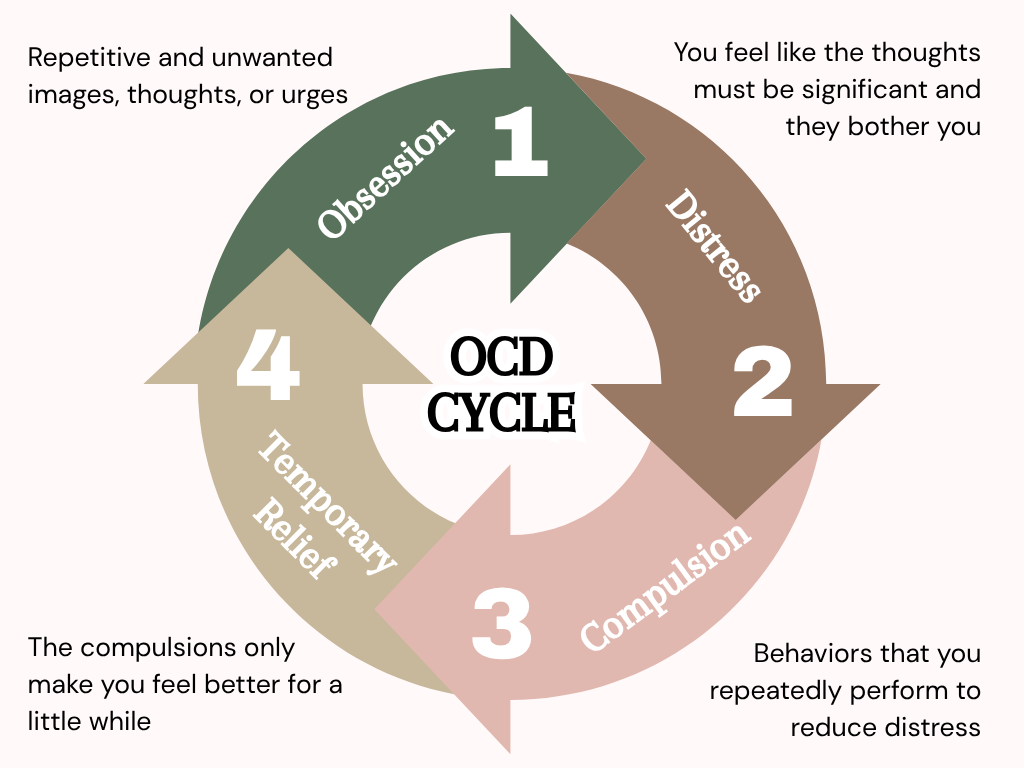
OCD often operates in a cycle that can feel difficult to break. An unwanted thought, image, or urge creates uncertainty or distress. In response, you may feel driven to do something to make the discomfort go away—such as checking, avoiding, seeking reassurance, researching, or mentally reviewing what happened. The compulsion may provide a sense of relief in the moment, but that relief teaches the brain that the thought or feeling must be addressed. Over time, this can make the cycle stronger and more persistent.
Breaking the cycle involves learning that you can experience uncomfortable thoughts and uncertainty without responding to them with compulsions. With appropriate treatment, you can gradually develop greater confidence in allowing thoughts to come and go without letting them control your life.
If OCD is interfering with your peace of mind or daily life, therapy can help you break free from the cycle and develop a healthier relationship with uncertainty and intrusive thoughts.
Source: NOCD
OCD vs. Anxiety
Source: NOCD
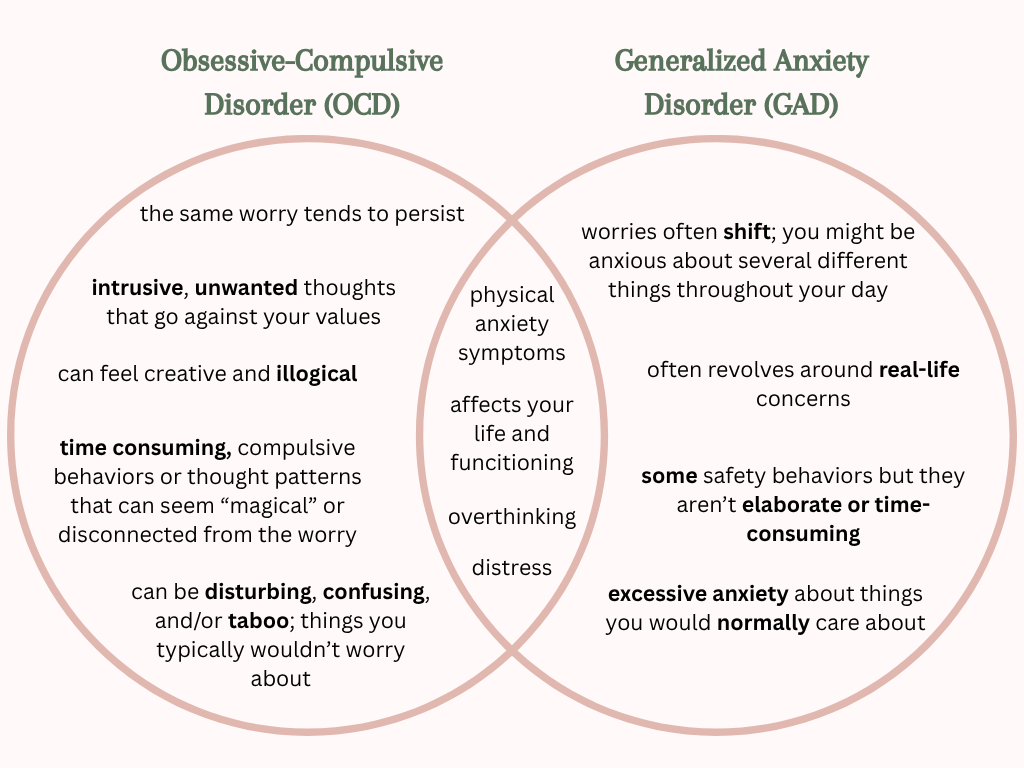
OCD and anxiety can look similar, but they are not the same. Anxiety often involves ongoing worry about everyday concerns, future events, or perceived threats. OCD involves unwanted, intrusive thoughts, images, or urges that can create intense distress, along with repetitive behaviors or mental rituals intended to reduce that distress or gain a sense of certainty.
For example, someone with anxiety may worry about whether they prepared enough for an upcoming event. Someone with OCD may become stuck questioning whether they made a mistake, repeatedly review what happened, seek reassurance, or feel compelled to check until they feel certain.
Both OCD and anxiety can be highly distressing, but OCD often involves a cycle of intrusive thoughts → distress → compulsions or reassurance → temporary relief. Understanding this difference is important because treatment modalities for OCD are highly specialized.
Treatment for OCD
Common treatment options for OCD include psychotherapy alone, medication alone, or a combination of psychotherapy and medication. If you’re wanting to explore medication, I can provide an appropriate psychiatrist referral. Below is a summary of psychotherapy modalities that are shown to be effective for OCD.
Exposure and Response Prevention (ERP)
ERP is currently the most established psychological treatment for OCD. The client deliberately approaches situations, thoughts, images, or sensations that trigger OCD while not performing the associated compulsion or avoidance behavior.
The therapeutic learning is not simply “nothing bad will happen.” Rather, patients learn that they can tolerate uncertainty and distress without relying on compulsions, and that intrusive thoughts do not require action.
TLDR: Face the trigger → don't perform the compulsion → learn you can tolerate uncertainty.
Acceptance and Commitment Therapy (ACT)
ACT shifts the emphasis from controlling thoughts to changing one's relationship with them. A client learns to notice an obsession without treating it as something that must be eliminated, analyzed, or acted upon.
ACT might emphasize accepting the presence of the thought and choosing behavior based on personal values rather than OCD demands.
ACT can therefore complement ERP, particularly when avoidance, thought suppression, or difficulty accepting uncertainty are prominent.
TLDR: Notice the obsession → accept its presence → act according to your values.
Inference-Based Cognitive Behavioral Therapy (I-CBT)
I-CBT proposes that OCD involves a problematic reasoning process in which a person becomes absorbed in an imagined possibility and begins treating that possibility as though it were reality.
For example: “I don't see evidence that I contaminated anything, but what if there is contamination I can't detect?”
I-CBT examines how the person arrived at that conclusion and helps distinguish what is directly known from what is being imagined or inferred. The aim is to reduce the need to investigate, check, ruminate, or seek reassurance.
TLDR: Examine the reasoning → distinguish possibility from reality → disengage from obsessive doubt.
Please note that ERP currently has the strongest overall evidence and is the most established first-line psychological treatment. ACT and I-CBT are important alternatives or complementary approaches, with growing evidence and potentially different advantages for particular clients. In practice, treatment choice can depend on a variety of different factors including symptom presentation, client preference, etc.
Common Misconceptions about OCD
OCD just means being clean or organized.
This is a common misconception heavily portrayed in media and entertainment. While there are subtypes of OCD that lead to an obsessive need for cleanliness and/or organization, simplifying OCD to just a preference is dismissive to the debilitating nature of the disorder.
Giving someone with OCD reassurance helps them.
Many loved ones of people with OCD provide reassurance in order to help alleviate discomfort. What they may not realize is that they are inadvertently contributing to the OCD cycle, which keeps the person with OCD stuck. As difficult as it is, loved ones have to be aware of reassurance-seeking behaviors and attempt to combat them by not providing the reassurance the person with OCD is seeking.
OCD compulsions are always visible and/or physical.
What makes proper OCD diagnosis tricky is that compulsions are not always visible and/or physical. Compulsions can be mental (e.g., reassurance-seeking, excessive rumination and replaying). This is called Pure O OCD.